Per Aspera Ad Astra
Airship background
The road of SZEPPELIN from an indoor helium airship to the high-altitude HAPS concept.
Why an airship?
Our experiments with meteorological balloons encourage us to go to a 'higher level'. Our goal is to reach an altitude of 50 kilometres with an airship equipped with radiocommunication devices. The ITU Radio Regulations (RR) define HAPS (high-altitude platform station) as a radio station located on an object at an altitude of 20–50 kilometres at a specified, nominal, fixed point relative to the Earth.
The student idea was born in 2021. If the enthusiasm of the students lasts and we can obtain some support for the implementation, we would join the international university competition representing our university and our country.
Related pages
Three phases
Based on the knowledge gained at Aero Drum Ltd, we split the plan into three phases. The experience of each phase feeds into the design of the next airship.
Phase 1
Indoor airship
Maximum length: 5 m · Lifting gas: helium
Phase 2
Outdoor airship
Minimum length: 5 m · Lifting gas: hydrogen
Phase 3
High-altitude airship
Minimum length: 16 m · Lifting gas: hydrogen
Design subgroups
Assembling the airship is a complex task requiring the coordinated, precise work of several subgroups.
Balloon design
Designing, procuring, building and testing a balloon of the right shape, volume and material.
Buoyancy design
Selecting the gas providing sufficient lift according to the safety rules of the given airspace, including the interface between the gas cylinder and the balloon during filling.
Radio control design
Designing, procuring, building and testing the system controlling the spatial movement of the airship and its power supply.
Payload design
Designing, procuring, building and testing the mission-specific payload and its power supply.
Advertising surface design
Designing, procuring and testing an advertising carrier of suitable size, mass and material, and preparing sponsor logos for print.
Regulation
Learning and enforcing the relevant legal and university rules during the design, testing and operation of the airship.
The story of the first flight
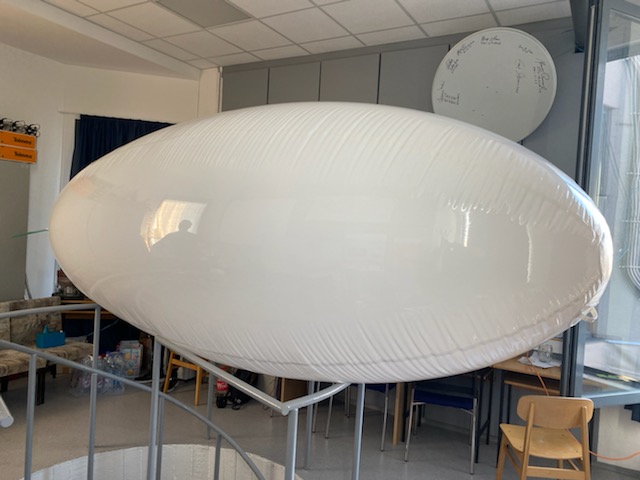
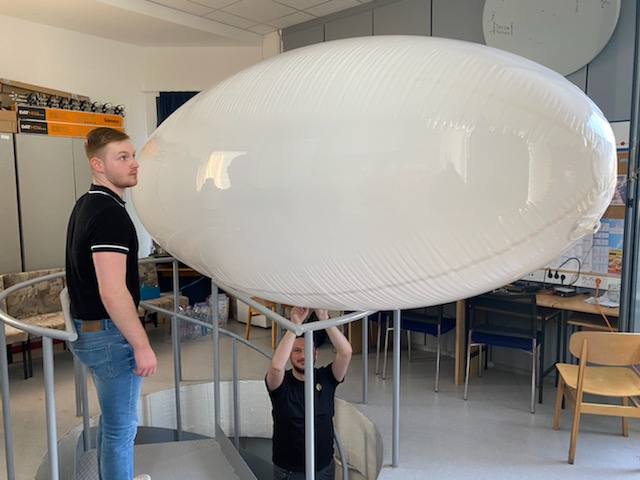
First we pressure-tested the envelope of the airship with air. After the successful test we checked the operation of the control unit.
Matching the World Telecommunication Day, the payload became a spectrum scanner with which we can check indoor mobile coverage. The scanner can also connect to the measurement network of the communications authority. The hardest puzzle was to keep the instrument as light as possible while its battery did not need replacing during the seven hours of the event. It is no secret that the factory battery had to be replaced with one used in aircraft modelling.
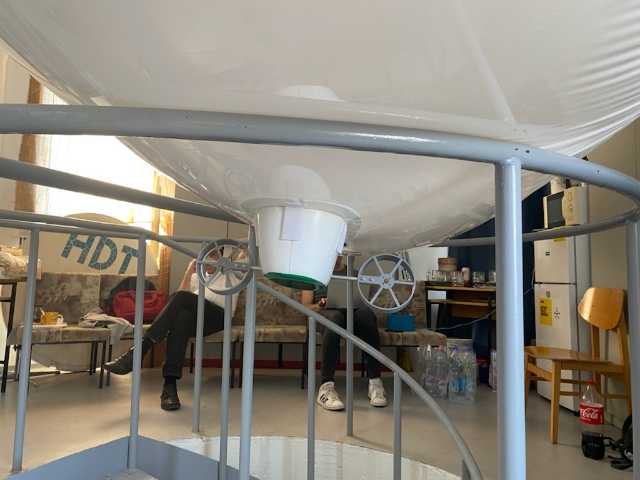
The balloon was filled with helium first, then the airship was safely anchored. Next came the control systems, the payload and finally the sponsor logos. The airship was ready for its first ascent.
What does it feel like to steer an airship? It is different from flying a model aircraft or a drone — perhaps closest to a submarine. After World Telecommunication Day we parked our airship in the Mobilis building so that as many people as possible could see it. We were also curious how long one filling lasts and how much lift it provides. The experience gathered helps us design and build an outdoor airship in the future.